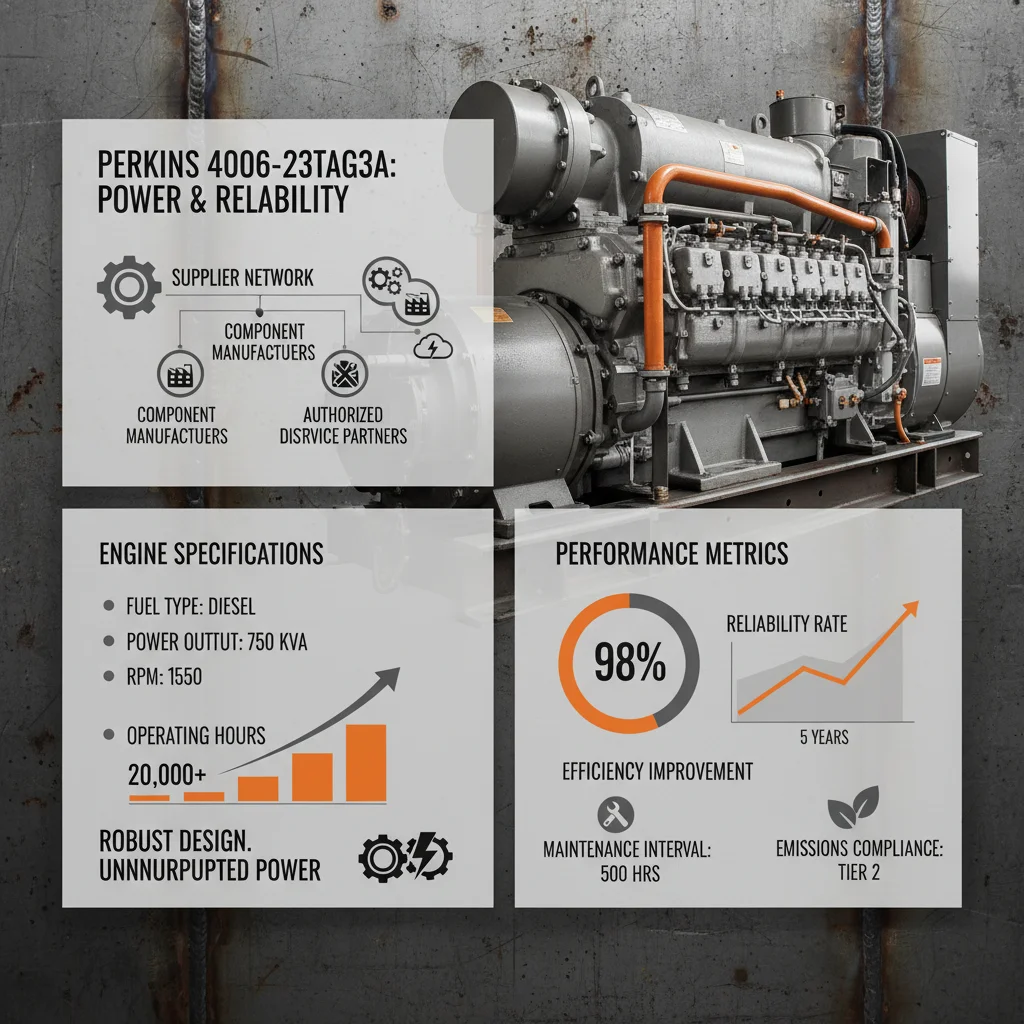
Selecting a power system for heavy industrial use often boils down to the balance between raw output and acoustic discipline. For projects requiring precise, reliable power in noise-sensitive environments, the integration of a high-performance engine like the Perkins 1103 series into a professional silent canopy is a critical architectural decision.
The challenge for EPC procurement teams is not just finding a generator, but identifying a perkins 1103a 33tg2 Supplier that can deliver a fully engineered solution. This involves more than just the engine; it requires an optimized enclosure system that handles vibration, heat dissipation, and strict emission standards without compromising the engine's lifespan.
This analysis explores the technical requirements for industrial silent power, the selection logic for heavy-duty generators, and how advanced engineering transforms a standard engine into a resilient, base-load power asset for global infrastructure.


Industrial noise reduction is not merely about adding a box around an engine. It is a complex discipline of managing sound waves and mechanical kinetic energy. In heavy-duty applications, the primary goal is to achieve a low decibel rating (typically 60-75 dB(A) at 7 meters) while ensuring that the engine does not overheat due to restricted airflow.
Modern solutions employ a multi-layered approach. High-density industrial acoustic foam absorbs high-frequency noise, while seismic vibration-dampening mounts decouple the engine from the steel chassis to prevent structural resonance. These elements, combined with engineered intake and exhaust silencers, allow massive output units to operate in noise-sensitive zones without violating municipal or industrial acoustic regulations.
The structural integrity of a silent diesel generator determines its operational longevity. Utilizing heavy-gauge steel enclosures and marine-grade corrosion-resistant materials is essential for units deployed in mining or coastal environments. These enclosures must be perfectly sealed to protect critical electronic control modules from dust and moisture, ensuring that the internal environment remains stable regardless of external weather extremes.
From a combustion perspective, the integration of electronically controlled diesel engines with high-pressure common rail fuel systems optimizes fuel efficiency. For those sourcing from a perkins 1103a 33tg2 Supplier, the focus is often on the seamless marriage between the engine's torque characteristics and the alternator's voltage stability. This synergy is what allows for "grid-level" power quality, which is non-negotiable for data centers and medical facilities.
Furthermore, the inclusion of advanced SCADA control systems transforms these units from standalone machines into networked assets. Cloud-based remote monitoring allows engineers to oversee performance metrics—such as oil pressure, coolant temperature, and load distribution—across multiple mega-sites in real-time, reducing the need for physical inspections and preventing catastrophic failures through predictive maintenance.
In the realm of prime power, the distinction between high-speed consumer engines and industrial-grade 1500 RPM engines is profound. For continuous base-load applications, a 1500 RPM configuration is the global standard because it drastically reduces the mechanical wear and tear associated with higher rotational speeds.
Lower engine speeds (1500 RPM) inherently lead to superior industrial fuel economy, eradicated structural vibration, and an engine lifespan that can span decades, making them mandatory for critical infrastructure projects.
This slower cadence also simplifies the acoustic challenge. Since lower RPMs generate less high-frequency noise and structural vibration, the enclosure system can be optimized for airflow rather than just sound suppression. This results in a more reliable cooling cycle, which is the single most important factor in preventing engine derating during peak summer loads in brutal environments.
Measuring the success of a silent generator requires an analysis of the "Noise Reduction Index" across different frequency spectrums. While many manufacturers claim "silent" operation, the actual efficacy depends on the quality of the acoustic foam and the sealing of the canopy. A truly engineered system minimizes leakage at the door seals and cable entry points, where sound often escapes.
The following index provides a relative assessment of how different enclosure materials and design choices impact the overall acoustic performance of heavy-duty units. This illustrative model compares standard open sets against advanced containerized silent solutions.
The application of these systems varies based on the required duty cycle. In a typical industrial setting, such as a hyperscale data center, the focus is on seamless ATS (Automatic Transfer Switch) integration and grid-synchronization. These facilities require units in the 1200kVA to 2500kVA range that can transition from standby to full load in seconds without voltage spikes that could damage server hardware.
Conversely, in mining conglomerates or national utility infrastructure, the priority shifts toward mobility and resilience. Mobile silent diesel generators, often containerized, allow for the deployment of power to remote exploration sites. These units must withstand extreme ambient temperatures and heavy dust, making the marine-grade sealing and robust cooling systems provided by professional manufacturers indispensable.
Environmental compliance has moved from a "nice-to-have" to a legal mandate. Modern industrial generators must comply with EPA Tier 4 Final and EU Stage V standards to be deployed in most developed markets. This has led to the integration of complex after-treatment technologies, including Diesel Particulate Filters (DPF) and Selective Catalytic Reduction (SCR).
These systems use urea-based fluids to convert nitrogen oxides into harmless nitrogen and water, significantly reducing the carbon footprint of heavy power generation. However, these additives introduce new maintenance requirements, requiring the procurement team to ensure that their supplier provides a comprehensive global service network for genuine spare parts and technical assistance.
The industry is also seeing a shift toward "hybrid readiness." Many new containerized solutions are being designed to integrate with utility-scale battery storage. This allows the diesel generator to handle the base load while batteries manage peak spikes, further optimizing fuel consumption and reducing total operational expenditure (OPEX) over the equipment's lifecycle.
Procuring a heavy-duty silent generator requires an analysis of the total cost of ownership (TCO) rather than just the initial capital expenditure (CapEx). A lower-priced unit often carries higher fuel consumption and shorter maintenance intervals, which can erase any initial savings within the first three years of operation.
When evaluating a potential provider, procurement managers should look for evidence of rigorous load-bank testing. A unit that has been tested under simulated extreme environments is far more likely to maintain grid-level voltage stability during a real-world power failure.
To simplify the decision process, the following framework compares common industrial power requirements against the most suitable configuration.
| Application Type | Typical Capacity | Critical Priority | Recommended Config |
|---|---|---|---|
| Commercial Hubs | 600kVA - 1000kVA | Acoustic Compliance | Silent Canopy / 1500 RPM |
| Heavy Manufacturing | 1200kVA - 2500kVA | Continuous Stability | Open or Silent / Base-load |
| Mining Sites | 2500kVA + | Environmental Resilience | Containerized / Marine-grade |
| Data Centers | 1000kVA - 3000kVA | Response Time (ATS) | Silent / SCADA Integrated |
| Temp Construction | 250kVA - 650kVA | Industrial Mobility | Mobile Silent / Skid-mounted |
| Medical Facilities | 500kVA - 1500kVA | Zero-Failure Reliability | Silent / Redundant Parallel |
A professional industrial silent generator uses a holistic engineering approach. Unlike standard units that merely add sound-absorbing foam, industrial versions integrate seismic vibration-dampening mounts, engineered intake/exhaust silencers, and heavy-gauge steel enclosures. These elements work together to reduce noise levels to 60-75 dB(A) without restricting the airflow necessary for cooling the engine during continuous base-load operation.
1500 RPM engines are designed for durability and efficiency over long periods. Compared to high-speed engines, they experience significantly less mechanical friction and heat, which leads to a longer overall engine lifespan and reduced maintenance frequency. This makes them ideal for critical infrastructure where unplanned downtime is not an option.
EU Stage V and EPA Tier 4 Final standards require the use of advanced after-treatment technologies like DPF (Diesel Particulate Filter) and SCR (Selective Catalytic Reduction). This means the generator will require a urea tank and specialized maintenance. Buyers must ensure their supplier can provide these compliant units and the necessary technical support to maintain the emissions systems.
Yes, containerized solutions are specifically designed for industrial mobility. They protect the alternator and engine from brutal conditions—such as mining dust or extreme moisture—and are easy to transport via truck or ship. This makes them perfect for extreme temporary power needs in remote regions.
Pricing is primarily driven by the power rating (kVA), the engine manufacturer (e.g., Perkins or Cummins), the quality of the alternator, and the level of integration. Advanced features like SCADA cloud monitoring, Stage V compliance, and custom offshore-grade corrosion protection significantly increase the initial CapEx but lower the long-term OPEX.
Preventing overload starts with an accurate peak load profile analysis. It is crucial to account for "in-rush current" (the surge when large motors start). If a unit is undersized, it can lead to catastrophic failure. Conversely, oversizing wastes fuel and increases CapEx. Consulting with an engineering team to match the equipment list to the generator capacity is the safest approach.
The transition toward sustainable, quiet, and efficient industrial power is an engineering necessity. Whether deploying a single unit for a commercial hub or a fleet of containerized generators for a mining project, the focus must remain on the synergy between the engine's performance and the enclosure's protective capabilities.
By prioritizing 1500 RPM stability, advanced acoustic engineering, and strict emission compliance, enterprises can secure a power infrastructure that is both resilient and environmentally responsible. Partnering with an experienced manufacturer ensures that these complex technical requirements are met with precision, providing absolute peace of mind for global EPC teams.

Hit enter to search or ESC to close