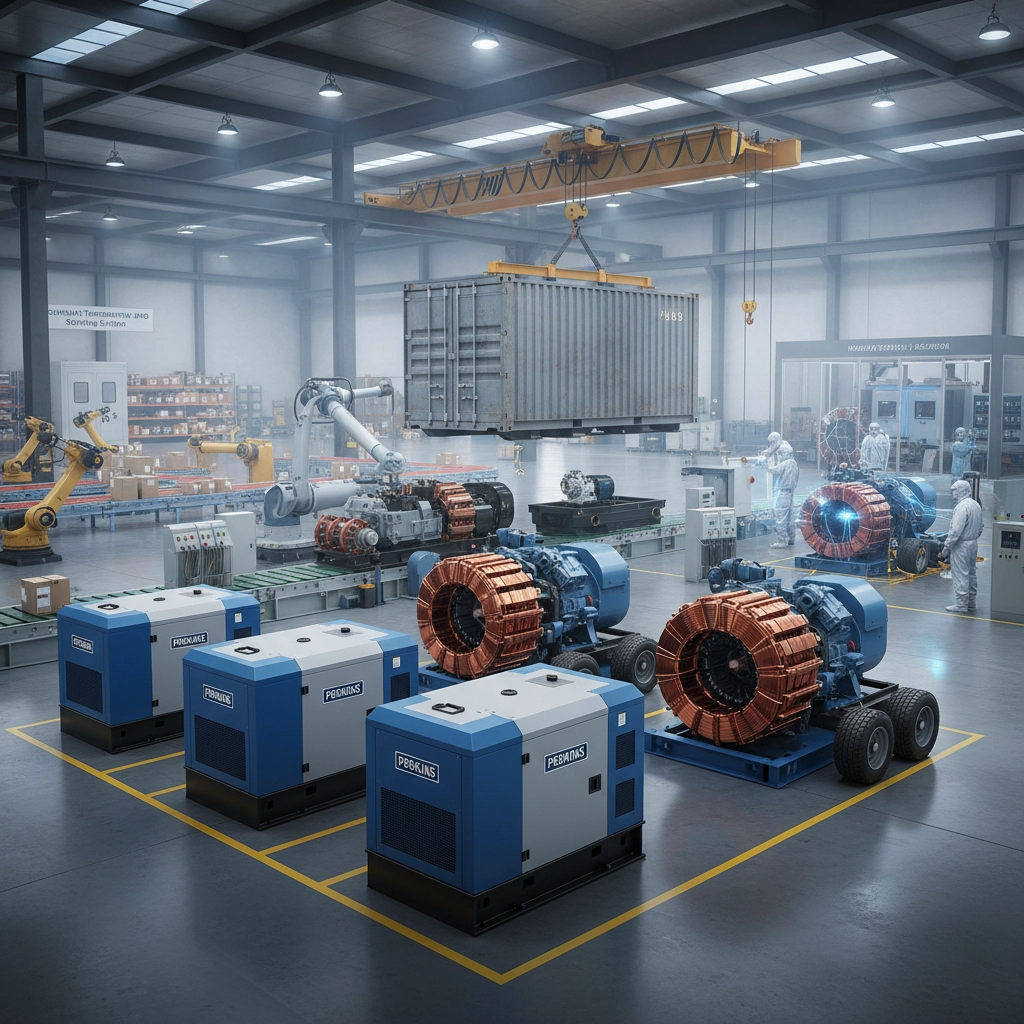
Selecting a reliable cummins industrial generators Supplier is often the difference between seamless operational continuity and catastrophic downtime in heavy industry. For procurement managers in the electrical machinery sector, the challenge lies not just in acquiring the engine, but in ensuring the total system integration—from the alternator to the control panel—meets rigorous industrial standards.
Industrial power demands are evolving, with a shift toward hybrid configurations and stricter emission compliance. Whether it is a container-type diesel unit for remote mining or a silent generator for urban healthcare facilities, the technical synergy between the Cummins power plant and the manufacturer's assembly quality determines the long-term Total Cost of Ownership (TCO).
This analysis explores the critical evaluation metrics for sourcing industrial power solutions, the technical trade-offs in generator configurations, and how to validate a supplier's capacity to deliver OEM/ODM customizations that align with specific site requirements.

The Strategic Role of a Specialized Power Equipment Partner

Many organizations make the mistake of viewing a cummins industrial generators Supplier as a mere equipment vendor. In reality, the supplier acts as a systems integrator. The engine is only one part of the equation; the fuel system, cooling capacity, and electrical protection circuitry must be precisely matched to the engine's performance curve to prevent premature wear and efficiency loss.
A professional manufacturer, such as Dianbida Power Equipment, leverages decades of experience in the electrical machinery and equipment industry to bridge the gap between raw engine specs and field reality. This involves rigorous load bank testing and the implementation of IP-rated enclosures that protect sensitive electronics from harsh industrial environments.
When evaluating a partner, the focus should shift from the initial purchase price to the operational reliability. A supplier capable of providing full OEM and ODM services ensures that the final product is not a "one size fits all" unit but a tailored solution optimized for the specific ambient temperature and load profile of the client's facility.
Technical Core: Evaluating Engine Integration and Control Systems
The technical value of an industrial generator is defined by its response to transient loads. High-quality integration ensures that when a heavy motor starts, the voltage dip is minimized and the engine recovers its frequency within seconds, preventing downstream equipment from tripping.
Control systems like DeepSea or ComAp are industry standards for a reason. They provide the necessary telemetry for remote monitoring and the logic required for parallel operation. A sophisticated supplier will customize these controllers to include specific alarms for fuel leaks, coolant temperature spikes, and oil pressure drops, providing a proactive maintenance layer.
Furthermore, the choice of canopy—whether it is a mobile silent diesel generator or a massive container-type unit—impacts thermal management. Poorly designed airflow in a silent canopy can lead to "heat soaking," where the engine overheats despite the radiator functioning correctly, simply because the hot air cannot escape the enclosure.
Critical Application Scenarios for Industrial Power Sets
Different industrial environments demand vastly different engineering approaches. In data centers and healthcare, the priority is "zero-fail" reliability, requiring automatic transfer switches (ATS) and parallel systems that can take over the load in under 10 seconds.
In contrast, construction and mining sites require "ruggedized" mobility. Mobile silent diesel generators must withstand high vibration and dust infiltration. Here, the focus is on IP54 or IP55 protection classes and reinforced chassis that can handle off-road transport without compromising the alignment of the engine and alternator.
For agricultural and irrigation operations, fuel versatility becomes a key driver. The integration of natural gas generators or biodiesel-compatible diesel units allows operators to hedge against fuel price volatility while maintaining the high torque necessary for heavy-duty pumping stations.
Comparative Performance Metrics: Standard vs. Optimized Systems
The difference between a generic assembly and a professionally engineered industrial system is most evident in fuel efficiency and downtime rates. Optimized systems utilize precision-tuned cooling and exhaust paths to maintain the engine in its peak thermal window.
When comparing standard imports to those from experienced manufacturers, we see a marked difference in the "Mean Time Between Failures" (MTBF). This is largely due to the quality of ancillary components—such as high-grade radiators and vibration-damping mounts—which are often downgraded in low-cost alternatives.
cummins industrial generators Supplier Performance Metrics
As illustrated, the optimized systems provide higher reliability in extreme temperatures and lower fuel consumption per kWh, directly impacting the bottom line over a 5-year operational cycle. These gains are achieved through rigorous load testing and the use of premium components that exceed basic industry minimums.
Procurement Framework for Large-Scale Power Deployments
Procuring industrial power is a risk management exercise. The primary risk is not the initial cost, but the "hidden cost" of unplanned downtime. A robust procurement framework must include a detailed technical audit of the supplier's manufacturing facility and their quality control protocols.
Verification of certifications (ISO 9001, CE, EPA) is a baseline, but the real proof lies in the load bank test reports. Any reputable supplier should provide a full test report showing the unit's performance at 25%, 50%, 75%, and 100% load over a sustained period.
Furthermore, after-sales infrastructure is critical. A supplier that offers 24/7 technical assistance and has a streamlined spare parts dispatch system is far more valuable than one that simply ships a unit and disappears. Proactive maintenance contracts should be negotiated at the time of purchase.
Future Directions in Industrial Power Generation Technology
The industry is moving toward "intelligent power," where generators are no longer isolated units but nodes in a smart grid. We are likely to see an increase in the adoption of remote diagnostic tools that use AI to predict component failure before it occurs, reducing emergency repair costs.
Environmental regulations are also pushing the market toward hybrid solutions. The combination of large-scale battery storage (BESS) with diesel generators allows the engine to run at its most efficient constant load, while the batteries handle the transient peaks, significantly reducing fuel consumption and emissions.
Additionally, there is a growing trend toward modularity. Containerized solutions that can be easily expanded by adding parallel units allow companies to scale their power capacity in line with their business growth without requiring a complete overhaul of their electrical infrastructure.
Decision Matrix for Industrial Generator Configuration Selection
Choosing the right configuration depends on a careful balance of environmental constraints, load characteristics, and budget. A silent canopy is essential for urban areas, but an open skid is often more practical for indoor plant rooms with dedicated ventilation.
The following matrix provides a comparative look at common industrial configurations to help procurement officers align their technical requirements with the most suitable product category.
| Configuration Type | Primary Use Case | Key Technical Advantage | Critical Constraint |
|---|---|---|---|
| Silent Diesel Gen | Urban/Residential Areas | Low noise (dB) pollution | Higher initial cost |
| Container Type | Remote Mining/Oil Rig | Integrated weather protection | High transport logistics |
| Mobile Trailer | Emergency/Event Power | Rapid deployment & mobility | Limited fuel tank size |
| Open Skid Gen | Industrial Plant Rooms | Maximum airflow & cooling | High noise levels |
| Natural Gas Gen | Fixed Factory Installations | Lower fuel operational cost | Requires gas pipeline |
| Parallel System | Data Centers/Hospitals | Redundancy (N+1) capability | Complex control logic |
Ultimately, the selection should be validated by a technical consultation with the supplier to ensure that the chosen configuration can handle the specific starting current of the onsite equipment. For those evaluating these options, detailed specifications are available via www.dbddg.com.
Frequently Asked Questions
Conclusion
Securing industrial power is an investment in operational resilience. The value provided by a competent cummins industrial generators Supplier extends far beyond the hardware; it encompasses the engineering precision of the integration, the reliability of the control logic, and the certainty of long-term support.
By focusing on total cost of ownership and technical compatibility rather than initial price, organizations can ensure that their power infrastructure supports growth rather than hindering it. Those seeking professional-grade power solutions can explore the full range of capabilities and configurations at www.dbddg.com.